
787 974 136
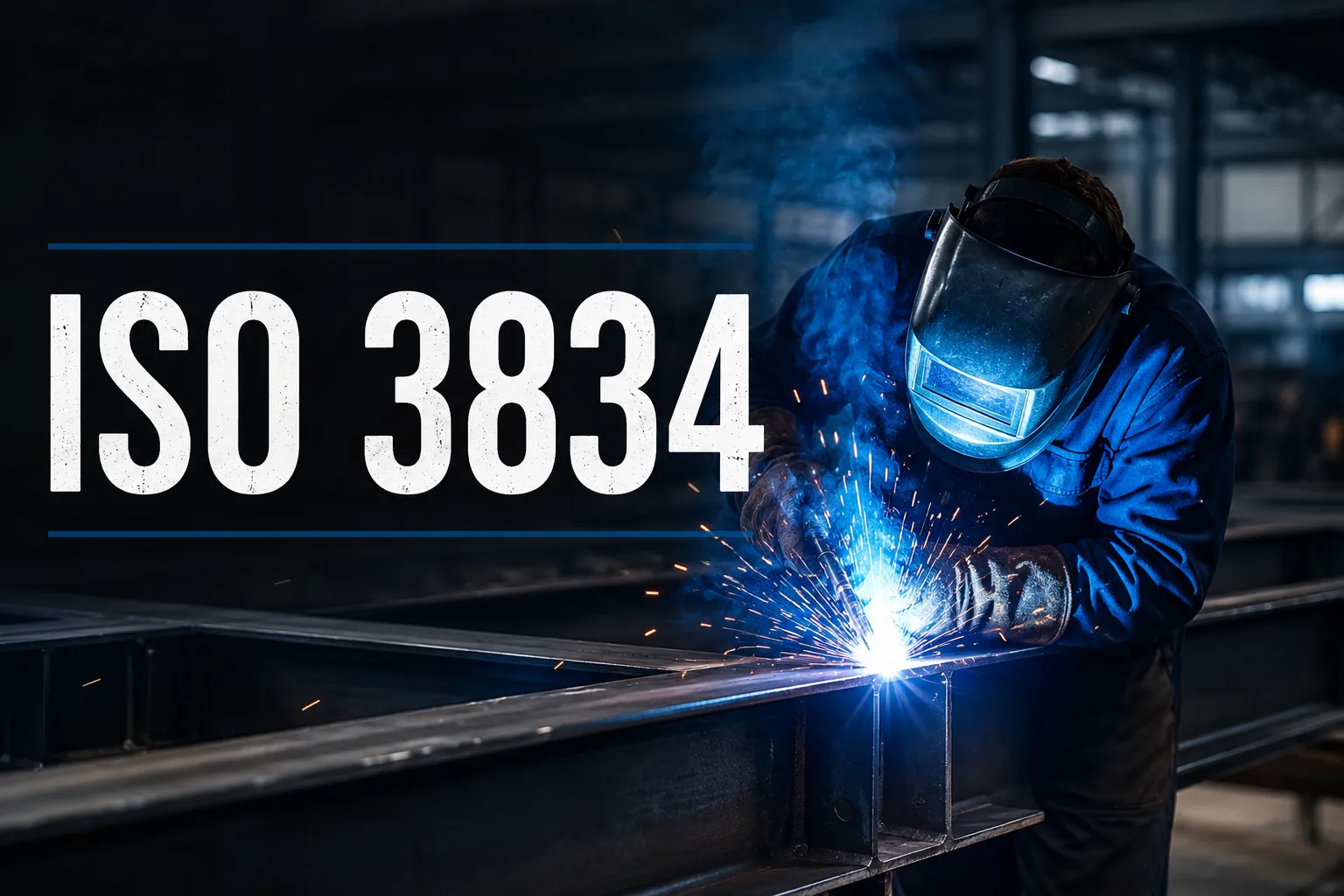
There are industries where a welder’s good will and experience are no longer enough. The pressure vessel, energy, railway and defence industries – in all these sectors, before signing a contract, clients ask one question: do you have ISO 3834? For many welding companies, this question ends the conversation before it has even properly begun. For those with the certificate, it opens doors that others cannot even see.
ISO 3834 is an international standard specifying requirements for the quality of welding of metallic materials. Unlike general quality management systems – such as ISO 9001 – this standard focuses exclusively and precisely on the welding process: from welder qualification and material selection, through process supervision, to inspection of the finished product.
The standard has three levels of requirements: Part 2 (comprehensive), Part 3 (standard) and Part 4 (basic). The appropriate level is selected depending on the complexity of the products and the customer’s requirements. In practice: the more demanding the customer and the higher the risk associated with the product, the higher the standard level required.
→ ISO 3834 is not a certificate for welders. It is a certificate for the company – confirmation that the entire welding management system operates in accordance with international standards.

The short answer: the most demanding customers in the market. The longer answer shows just how broad this group is.
There is one common denominator: these customers require assurance that the welded joint will not fail. ISO 3834 provides that assurance.
Prices can be lowered. Deadlines can be shortened. But ISO 3834 certification requires time, commitment and a genuine overhaul of working practices – and that is precisely why it is such a valuable competitive advantage.
A company with ISO 3834 enters discussions with a client from a completely different position. It does not need to explain that it ‘cares about quality’ – it has proof of this. It does not need to convince the client that its welders are qualified – the documentation speaks for itself. This changes the dynamics of negotiations: the conversation shifts from price to value.
→ Companies with ISO 3834 certification regularly win contracts not because they are the cheapest – but because they are the safest choice for the client.
What is more, ISO 3834 certification is often a prerequisite for obtaining other industry certifications and approvals – such as EN 1090, EN 15085 or UDT requirements. A company that holds ISO 3834 certification lays the foundation for its entire quality system.
Not having ISO 3834 certification rarely spells immediate disaster. It means something worse – a slow drift out of the market, which you may not notice for a long time.
✓ Every year without ISO 3834 is a year in which your certified competitors strengthen their relationships with customers to whom you have no access.


DJB DORADZTWO
Marcin Chorąży


