
787 974 136

Companies encountering the AQAP requirement for the first time often ask the same question: is it just another version of ISO 9001, or a completely different standard? The answer lies somewhere in between. AQAP is based on the foundations of ISO 9001, but goes much further — it is a standard developed specifically for suppliers to the military and NATO defence organisations. And it is precisely this specificity that means it cannot be replaced by any other certificate.
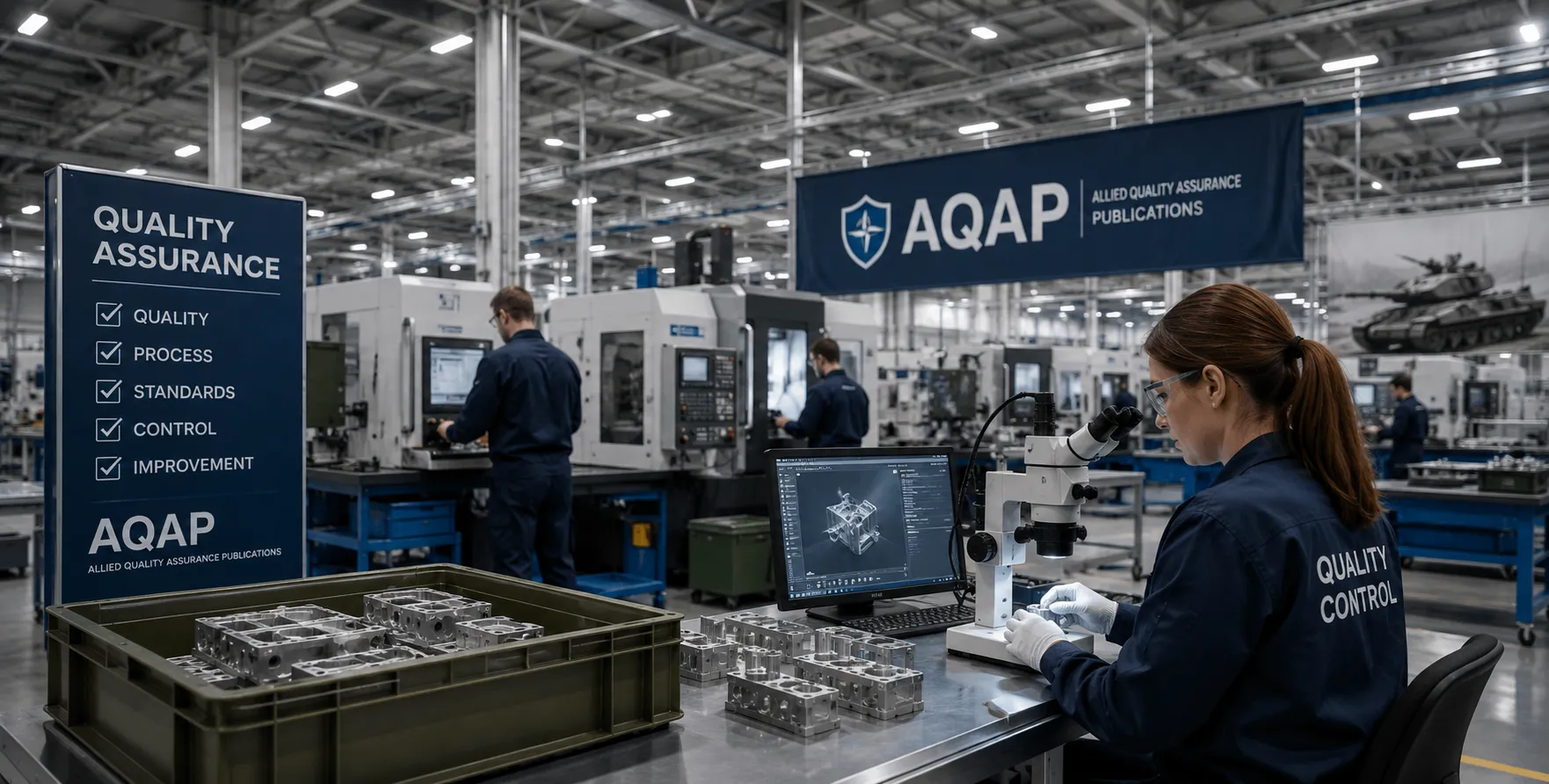
AQAP stands for Allied Quality Assurance Publications. These documents are developed and published by NATO as part of the Allied Standardisation System (STANAG 4107). Their aim is to ensure that products and services supplied to NATO military units meet uniform, rigorous quality requirements — regardless of the country in which the supplier operates.
The history of the standard goes back several decades, but its current form — based on the structure of the ISO 9000 standards — is the result of modernisation carried out in recent years. As a result, AQAP is now understandable to companies that already have experience with quality management systems, whilst at the same time introducing requirements not covered by ISO 9001.
The AQAP standard is available in several versions, tailored to different types of business and levels of criticality of the products or services supplied.
AQAP 2110 is the most comprehensive variant, covering the full range of requirements for quality management systems in design, development and production. It is used by companies supplying complex systems or components requiring supervision at the design stage.
AQAP 2120 applies to production without a design phase — for companies that manufacture products according to supplied technical documentation, without conducting their own development work.
AQAP 2130 covers quality control and testing — it is used by entities involved in the verification and testing of defence products, not necessarily their manufacture.
The choice of the appropriate variant depends on the nature of the company’s activities and the requirements set by the military contracting authority. In practice, AQAP 2110 or 2120 is most commonly implemented.
ISO 9001 is the foundation — and companies seeking AQAP certification must already hold it or implement it in parallel. AQAP does not replace ISO 9001, but extends it with requirements specific to the defence sector.
The most important additional elements include: requirements for Government Quality Assurance (GQA), i.e. the ability for a representative of the contracting military authority to verify quality directly at the supplier’s premises; extended requirements regarding configuration management and product traceability; a more rigorous approach to risk management in the production process; and detailed requirements regarding quality documentation and records, which must be retained for a specified period and in a specified manner.
These elements make AQAP certification a demanding process — but also ensure that the certificate carries real weight in the eyes of military contracting authorities and defence institutions.
The standard covers a wider range of companies than one might think. The obvious recipients are manufacturers of military equipment, vehicles, weapons, ammunition and electronic systems for the armed forces. However, AQAP also applies to suppliers of components and sub-assemblies used in defence systems, companies providing maintenance and repair services for military equipment, manufacturers of clothing, footwear and personal equipment for soldiers, as well as suppliers of software and IT systems for defence institutions.
There is one criterion: if a company supplies a product or service to the military — whether its own or an ally’s — and the contract requires quality certification, AQAP is the standard that must be met. There is no room for alternatives here — the military contracting authority does not accept substitute certificates.



DJB DORADZTWO
Marcin Chorąży


