
787 974 136
From the outside, the TRACES NT system looks like a standard form to fill in – account, company registration, declaration. In practice, it is one of those administrative processes where a seemingly minor decision made on the first screen can block the ability to submit a DDS declaration for many weeks, just before the deadline for placing goods on the market.
We work with companies that tried to complete the registration process on their own before contacting us – and the patterns of errors recur so regularly that it is worth describing them before another company makes the same mistakes. We assume a basic understanding of the regulation here – if you first need to get to grips with what the EUDR actually is and when it comes into force, start with that. Below are the seven most common pitfalls that importers and processors encounter when first using the TRACES system and the DDS procedure.
TRACES distinguishes between operators based on their position in the supply chain – the company placing the goods on the EU market for the first time (known as ‘upstream’) and the company operating at a later stage (downstream). Following the amendment to the Regulation in December 2025, this distinction has direct legal implications: only the first entity placing a product on the market is required to submit a full DDS declaration; others may refer to the supplier’s reference number.
The problem is that many companies do not know from the outset which category they fall into – especially when they import part of their production themselves and purchase the rest from an EU distributor. Selecting the wrong role during the entity registration stage means, in practice, that the notification must be corrected with the authorising authority, which can prolong the entire process by several weeks.
The EU Login account, which is used to access TRACES, must be linked to a specific individual – not to an email address such as biuro@firma.pl or compliance@firma.pl. Declarations submitted via the system are legally binding and are attributed to the person who signs them. Companies that set up a ‘collective’ account later encounter problems with determining responsibility for declarations and with transferring access when the person responsible changes role or leaves the company.
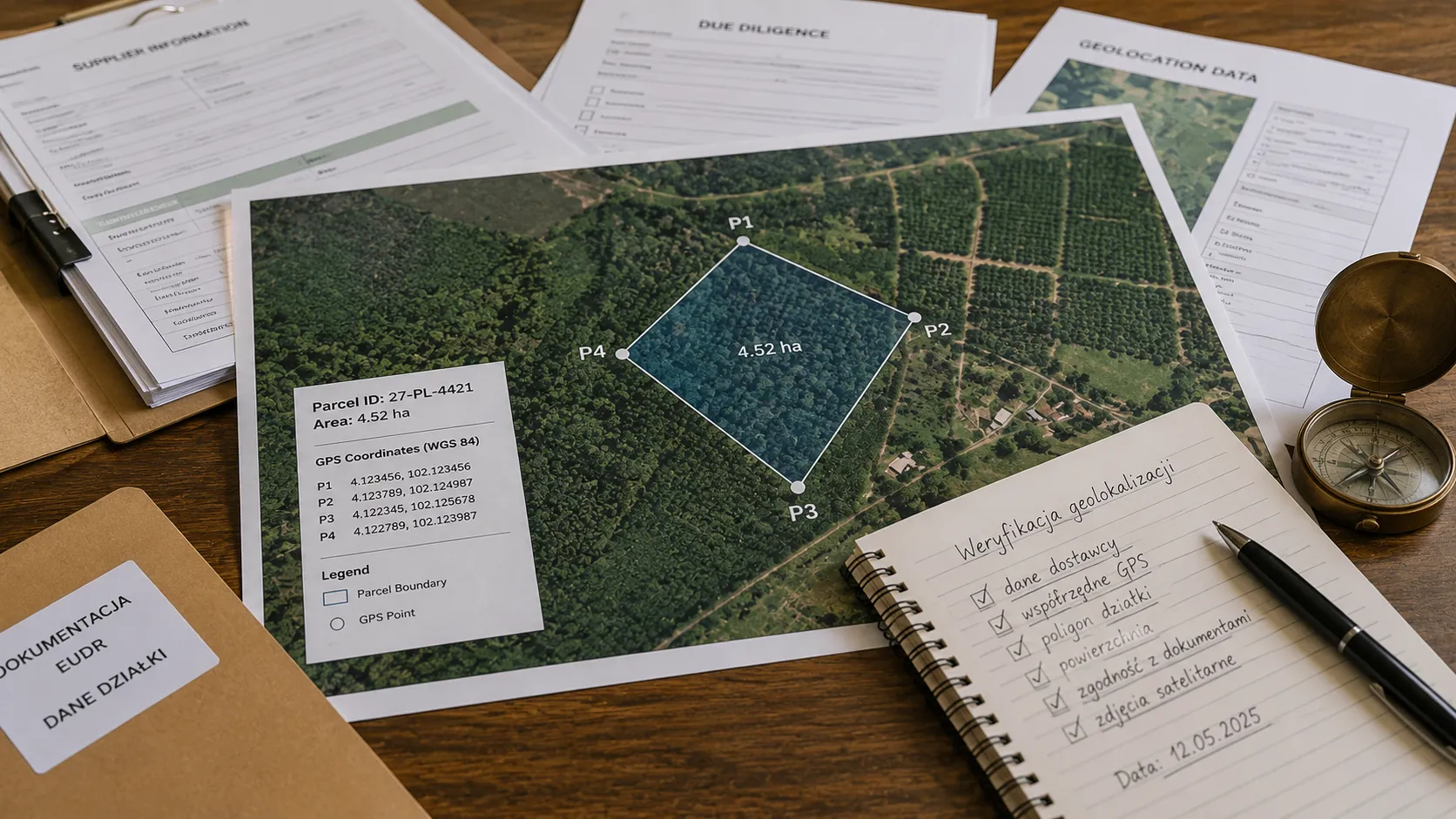
This is the most common factual error in initial DDS declarations. The system requires the GPS coordinates (for plots up to 4 ha) or the polygon (for plots larger than 4 ha) of the specific plot on which the raw material was produced or harvested – not the address of the supplier’s registered office, warehouse or transhipment port. Companies that have not clarified this requirement with their supplier early enough only discover the problem when they come to complete the declaration – when there is very little time left to provide the missing information. This is felt particularly acutely in sectors with fragmented, multi-stage supply chains, such as importers of cocoa, coffee and palm oil, where the raw material enters the EU via many small intermediaries.

Certificates such as FSC, PEFC or RSPO do indeed facilitate the risk assessment required by the EUDR, but they do not replace the DDS declaration itself or the obligation to provide the plot’s geolocation. Companies that assume their certificate ‘takes care of’ registration in TRACES only hit a brick wall when they try to submit the declaration – and have to complete the documentation under time pressure, rather than doing so calmly in advance.
The system and the supervisory authorities expect full consistency between the DDS declaration and the invoice, transport documents and customs declaration – the same CN code, the same quantity, the same country of origin. In practice, discrepancies often arise where the data for the DDS is compiled by one person (e.g. the compliance department) and the commercial documents are prepared by another (the logistics or sales department) – without a joint verification process prior to dispatch.
Approval of an operator in TRACES by the competent national authority (in Poland, these include IJHARS, the Veterinary Inspection or the Environmental Protection Inspectorate, depending on the raw material) is not immediate. Companies that assume the entire process – from setting up an EU Login account to having the operator’s registration approved – will take ‘an afternoon’ regularly find themselves in a situation where the deadline for the regulations to come into force passes before the registration is formally approved, and without it, no DDS declaration can be submitted. This is one of the reasons why companies that act in advance gain a real advantage over those that wait until the last minute.
Registration and the initial declaration are not the end of the process, but merely the beginning. A supplier’s production plot may change from season to season; the supplier may add a new source of raw materials or change their intermediary. Companies that treated the implementation of TRACES as a one-off ‘set-and-forget’ project discover, upon the next delivery, that the data is out of date – and the error only comes to light at the customs clearance stage, which is the worst possible moment.
None of the above errors stem from a lack of diligence – they arise because EUDR documentation brings together expertise from several different areas at once: knowledge of the regulation itself and its recent amendments, working with the European Commission’s IT system, handling geospatial data, and coordination between the compliance and sales departments and suppliers. In companies undertaking this for the first time, these areas are rarely covered by a single person or team – and it is precisely at the interface between them that most errors occur.
Can an incorrectly selected operator role in TRACES be changed after registration?
Usually yes, but this requires contacting the authority responsible for approving the registration and undergoing re-verification – in practice, this means an additional waiting time, which companies wish to avoid as the deadline approaches.
Is it better to start the TRACES registration process on your own, or with an adviser from the outset?
It depends on the scale of the supply chain and the number of suppliers with whom geolocation data needs to be coordinated. The more fragmented the supply chain, the greater the risk of the errors described above – and the greater the benefit of having the process managed from the outset by someone who has already encountered these pitfalls in other companies.
What happens if an error in the DDS declaration is only discovered during an inspection?
The consequences may include, amongst other things, a temporary ban on placing the product on the market, the need to correct the declaration under time pressure and – depending on the nature of the breach – financial penalties imposed by the relevant national authority.
Registration with TRACES is just one part of preparing for the EUDR. We help companies navigate the entire process – you can find more information on our page about EUDR implementation.


DJB DORADZTWO
Marcin Chorąży


