
787 974 136
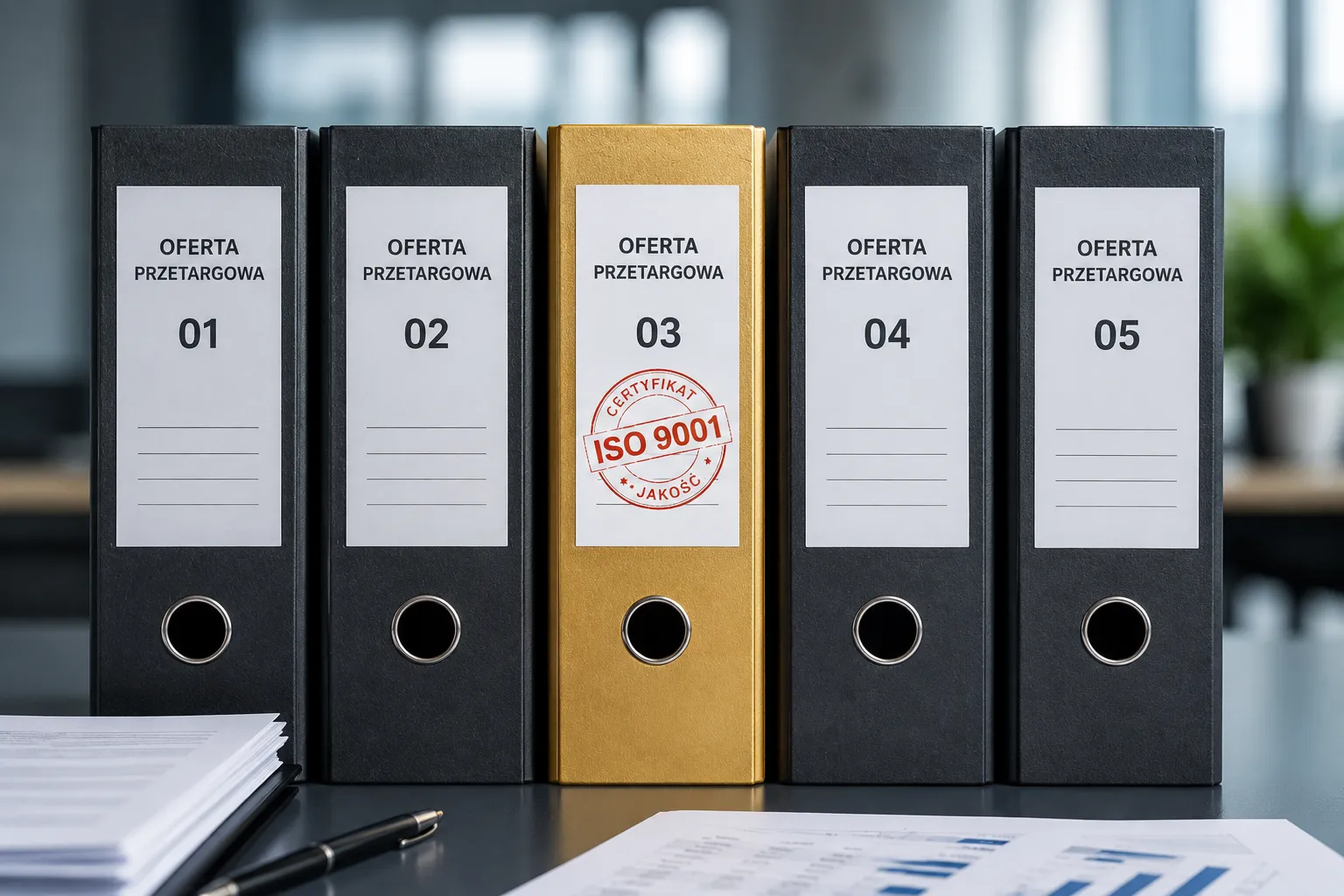
Many companies treat ISO 9001 as a document for the filing cabinet – something you need to have so that nobody asks questions. Meanwhile, companies that understand how the certificate works within their clients’ procurement processes use it quite differently: as an active sales argument that comes up early in the conversation and changes its dynamics. The difference between these two approaches is most clearly seen in tenders – both public and corporate – where ISO 9001 can determine the outcome before the question of price is even raised.
Public procurement law provides contracting authorities with tools to promote quality in two areas: the conditions for participation in the procedure and the criteria for evaluating tenders. ISO 9001 features in both.
As a condition for participation, the certificate is used less frequently — because contracting authorities must justify it and not every contract allows for this. It appears much more often as a quality criterion in the evaluation of tenders, where having a certified quality management system translates directly into extra points. In procedures where price accounts for 60% of the evaluation and the remaining 40% are quality criteria, a few points for ISO 9001 can move a bid from third place to first.
It is also worth bearing in mind the growing number of EU-funded tenders where requirements for quality management systems are enshrined in the programme guidelines. A company without ISO 9001 may be excluded from eligibility even before the substantive evaluation — not because it performs its services poorly, but because it cannot prove that it does so in a structured manner.
In the B2B sector, the mechanism works similarly, but at an even earlier stage in the procurement process. Large companies — particularly foreign-owned corporations, OEM manufacturers and firms in regulated industries — employ formal supplier qualification procedures. Before they even receive a bid, they assess potential partners for their ability to ensure quality.
ISO 9001 is a standard criterion in these procedures. A company without certification does not make it onto the list of approved suppliers — and does not take part in requests for quotation. It does not lose out in a tender. It simply is not invited to the table.
For a company seeking to expand sales to corporate clients, ISO 9001 is therefore not merely a matter of image. It is a gateway to a market segment that remains inaccessible without it.

The certificate also makes a difference in one-to-one business discussions — particularly when a client has no formal requirements but assesses a supplier’s reliability intuitively. ISO 9001 conveys a clear message: processes are documented, implementation is monitored, and the company has undergone an independent audit and does so regularly.
This is an argument that appeals to anyone who has ever had a problem with a supplier — missed deadlines, inconsistent quality, or a lack of response to complaints. ISO 9001 does not guarantee that these problems will not occur. But it does guarantee that the company has mechanisms in place to detect, address and prevent their recurrence. For a customer looking for a stable, long-term partner rather than the cheapest one-off deal, this is a difference that matters.
Companies that actively communicate their ISO 9001 certification — on their website, in their marketing materials, and in presentations — shorten the time it takes to build trust. A customer who sees the certificate before asking about quality asks different questions. Questions that are more substantive and closer to the purchasing decision.


DJB DORADZTWO
Marcin Chorąży


