
787 974 136
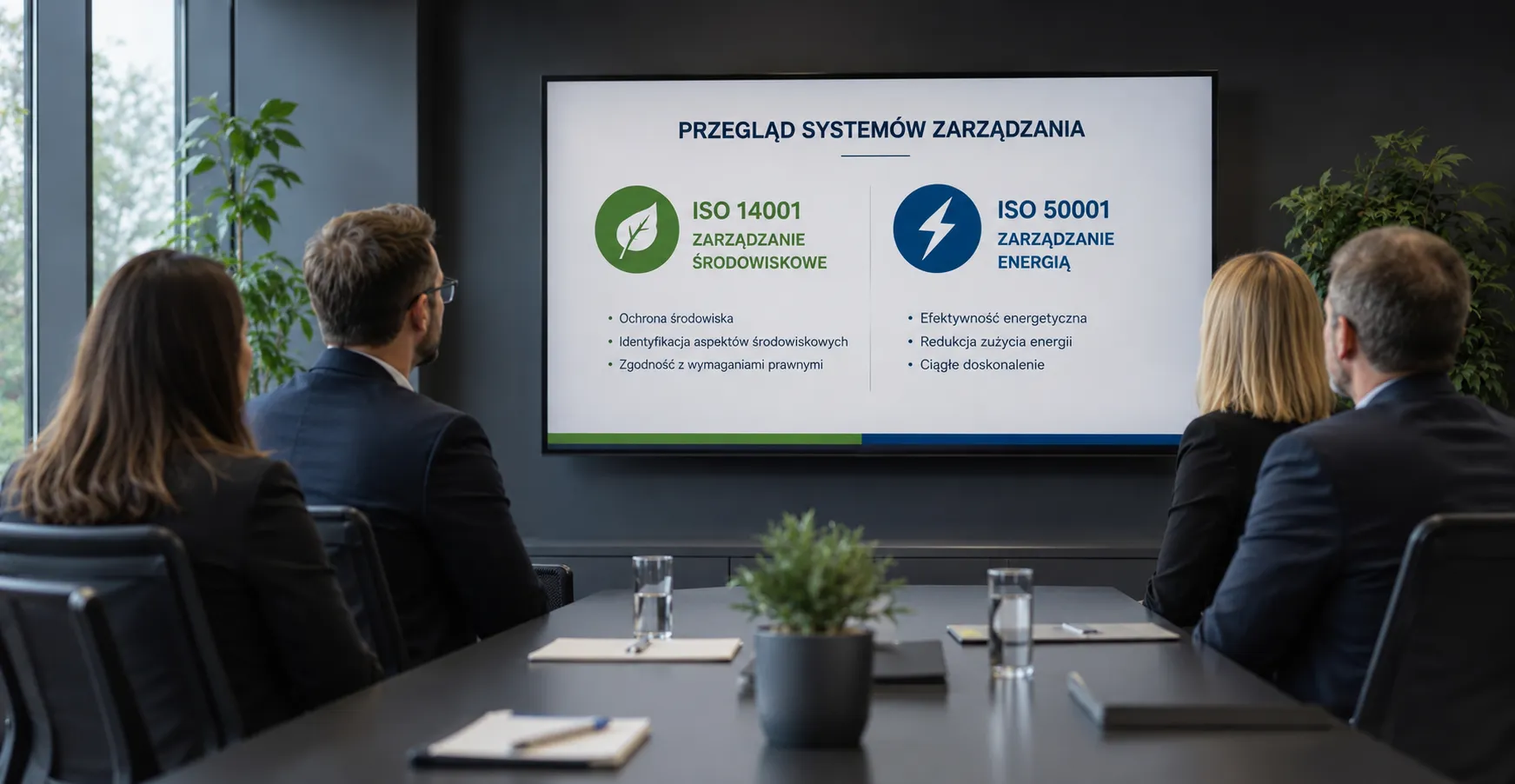
Many companies already hold ISO 14001 certification. When the topic of ISO 50001 arises, a common question is asked: “Isn’t that just the same as what we already have?” Not exactly the same – but more closely related than one might think. And it is precisely this relationship that is worth skilfully exploiting.
ISO 50001 and ISO 14001 belong to the family of ISO standards built on the so-called High Level Structure (HLS) – a standardised framework applicable to all modern management systems. This means that both standards share the same framework: organisational context, leadership, planning, support, operational activities, performance evaluation and improvement.
For a company that has already implemented ISO 14001, this is a tangible benefit. It does not start from scratch. Environmental and energy policies can be integrated into a single document. Management reviews – one review covers both systems. Internal audits – one auditor, one training course, one schedule. Documentation – a shared platform and consistent records.
It is estimated that companies holding ISO 14001 certification can reduce the time taken to implement ISO 50001 by as much as 30–40%. This represents a real saving in time and money. It is worth bearing in mind that many concerns regarding the costs and complexity of implementation stem from common myths about ISO 50001. We have discussed this topic in more detail in the article ‘ISO 50001 is for large factories. And other myths that cost companies money’
Despite their shared structure, ISO 50001 and ISO 14001 have fundamentally different focuses.
ISO 14001 asks: what impact does our organisation have on the environment and how do we minimise it? Energy is one of many environmental aspects – alongside waste, emissions, water consumption and noise. The standard does not require each of these to be managed in equal depth.
ISO 50001 asks: how efficiently do we use energy and how do we improve this efficiency each year? Here, energy is not one of many topics – it is the sole topic. The standard requires the identification of significant energy use areas (SEUs), the development of energy performance indicators (EnPIs), the establishment of a baseline, and the measurement of actual results.
In practice: a company with ISO 14001 certification may identify energy as a significant environmental aspect and enter the target ‘5% reduction in energy consumption’ into the register. ISO 50001 asks further: how do you measure it, in what units, in relation to what volume, on which production lines, and how often? And did you achieve it last year?
Companies that decide to integrate both systems highlight several specific benefits.
A single, coherent management review. Instead of two separate meetings and two sets of indicators – a single review covering both environmental and energy aspects. The management board sees the full picture: where the company stands in relation to its environmental targets and where it stands in terms of energy efficiency.
Synergy in internal audits. An internal auditor trained in both standards can conduct a single audit covering both systems. Less staff time spent on preparation, fewer disruptions to operational work.
A single report for stakeholders. Environmental and energy data in a single ESG or environmental report. An increasing number of companies are required to produce such reports – an integrated system significantly facilitates their preparation and ensures consistency.
Better visibility of trade-offs. Sometimes energy optimisation measures have environmental consequences, and vice versa. An integrated system allows you to recognise these interdependencies and make decisions with a full picture.
An integrated implementation makes sense right from the start when a company does not have either system in place and is starting from scratch – the documentation, structure and processes can be planned so that they support both standards from the outset.
When a company already has ISO 14001 and plans to add ISO 50001, the best approach is usually a sequential extension: first, mapping which elements of ISO 14001 can be directly extended and which require new processes (primarily the energy review and the EnPI indicator system), followed by the gradual implementation of the missing elements of ISO 50001 without disrupting what is already working.
The key question: does the organisation have the resources to undergo certification for both standards simultaneously? If so – it is worth it. If not – it is better to stabilise ISO 14001 and add ISO 50001 in the next step, rather than doing both at once only halfway.
ISO 50001 and ISO 14001 are neither competitors nor duplicates – they are complementary systems that together provide a more complete picture of resource and environmental management. For companies already holding ISO 14001, the path to ISO 50001 is shorter and cheaper than it seems. And for those just starting out – integrated implementation from the outset may be the most effective route.



DJB DORADZTWO
Marcin Chorąży


