
787 974 136

Companies that have expanded to several locations or entered foreign markets are all too familiar with this problem. At head office, processes are documented, implemented and run smoothly. At a branch in another city – things are a little different. At a subsidiary abroad – they do things entirely their own way. A customer served from Warsaw receives a different standard of service than one served from Wrocław or Bratislava. And no one really knows how to standardise this without creating a bureaucratic behemoth.
ISO 9001:2026 is not a cure-all — but in several key areas, it addresses this problem precisely. And it does so better than the previous version of the standard.
The 2026 update to the standard reinforces three areas that are of particular practical importance to companies operating across multiple locations.
The first is organisational knowledge management. ISO 9001:2026 places greater emphasis on ensuring that knowledge — about processes, best practices, errors and how to eliminate them — is not only documented but actively shared and accessible throughout the organisation. For a company with branches, this means the requirement to build a system in which experience gained in one location is not lost when an employee leaves and does not remain solely in the minds of a few people.
The second area concerns enhanced requirements regarding the organisational context and stakeholders. A branch in another country operates within a different regulatory, cultural and market environment. The new standard requires that these differences be consciously taken into account within the management system — not ignored in favour of a single template copied from head office.
The third area is the digitalisation of management processes. ISO 9001:2026 is the first version of the standard to explicitly refer to digital tools in quality management. For a multi-branch company, this means the green light — or rather a requirement — for quality management systems to operate in a digital environment, enabling real-time monitoring and reporting regardless of geography.
Implementing ISO 9001:2026 in a multi-site organisation differs from a traditional implementation within a single company. The key question is not ‘which procedures should be implemented?’ but ‘how can we ensure that the same standards operate consistently across environments that are not identical?’
The answer promoted by the new standard is based on distinguishing between what must be uniform and what can be localised. Customer requirements, quality metrics, non-conformity management processes and improvement mechanisms — these elements should be consistent across the organisation. Specific operating procedures, schedules and tools may be adapted to local conditions, provided they achieve the same objective.
Such a system architecture is easier to maintain than a single rigid quality manual copied to every branch — and more resilient to staff changes, geographical expansion and regulatory differences between markets.
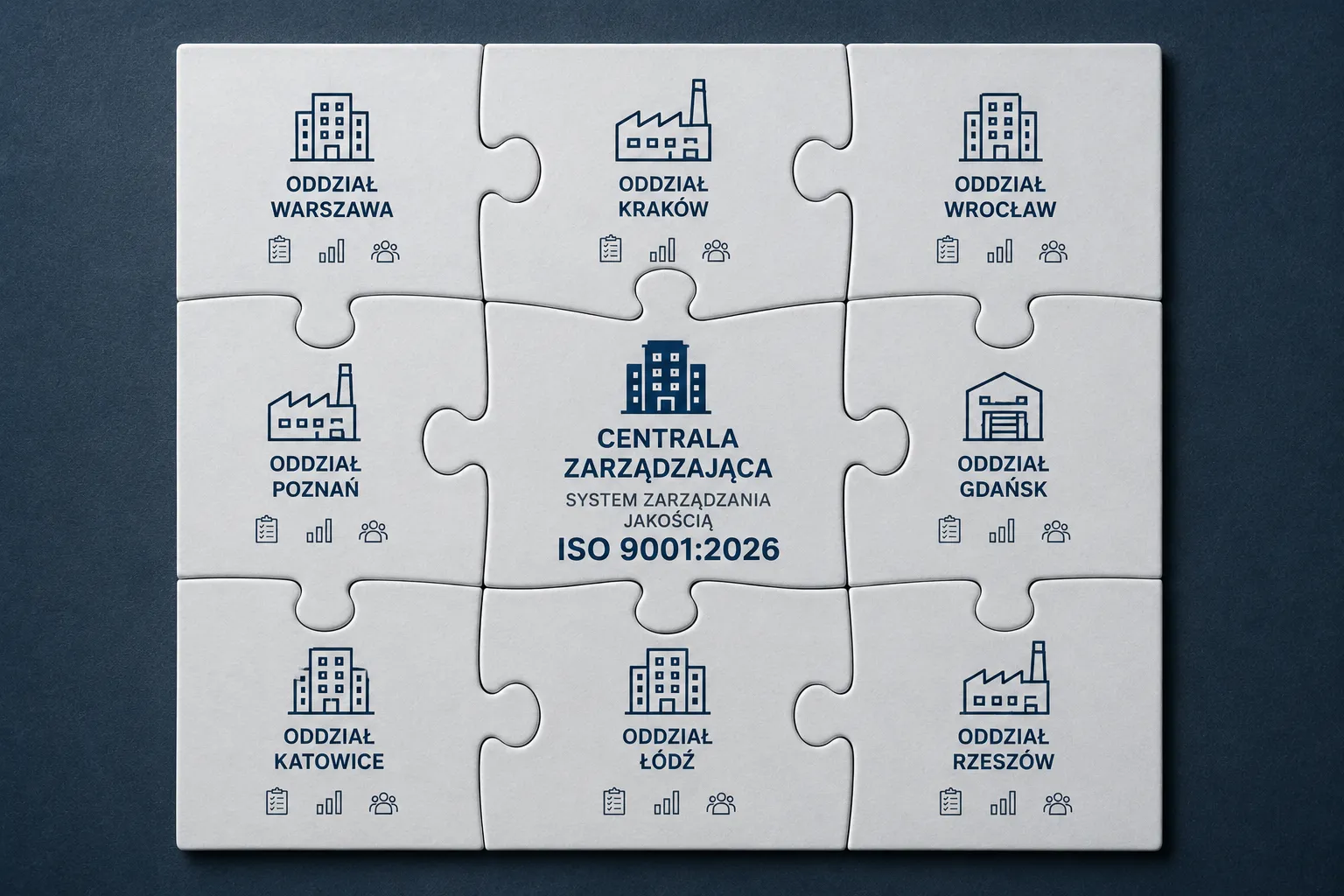
Companies operating in several countries face a barrier that is rarely spoken of openly: the lack of a common language of quality. Each branch has its own standards, its own understanding of ‘a job well done’ and its own tolerance thresholds for deviations. When a client moves between locations — or when a project is carried out by teams from different countries — these differences become apparent and costly.
ISO 9001 provides this common language. A certified organisation — regardless of how many branches it has or in how many countries it operates — has a single, consistent quality management system, verified by independent auditors. For a corporate client that itself operates in many countries and expects consistent quality from its suppliers, this is an argument that cannot be overstated.
For the organisation itself, the benefit is equally tangible: quality decisions are made on the basis of data from across the entire company, rather than the intuition of managers at individual sites.



DJB DORADZTWO
Marcin Chorąży


