
787 974 136
In many companies, energy management still relies on manual reports, Excel spreadsheets and retrospective data analysis. This model works only for basic cost control, but does not allow companies to respond to current deviations or optimise consumption in real time. With the advancement of digitalisation and Industry 4.0, this approach is increasingly being replaced by automated systems that integrate data from sensors, production systems and energy infrastructure into a single, coherent ecosystem. This approach is also a natural extension of the requirements of ISO 50001, which stipulates that energy management should be based on data and continuous improvement.
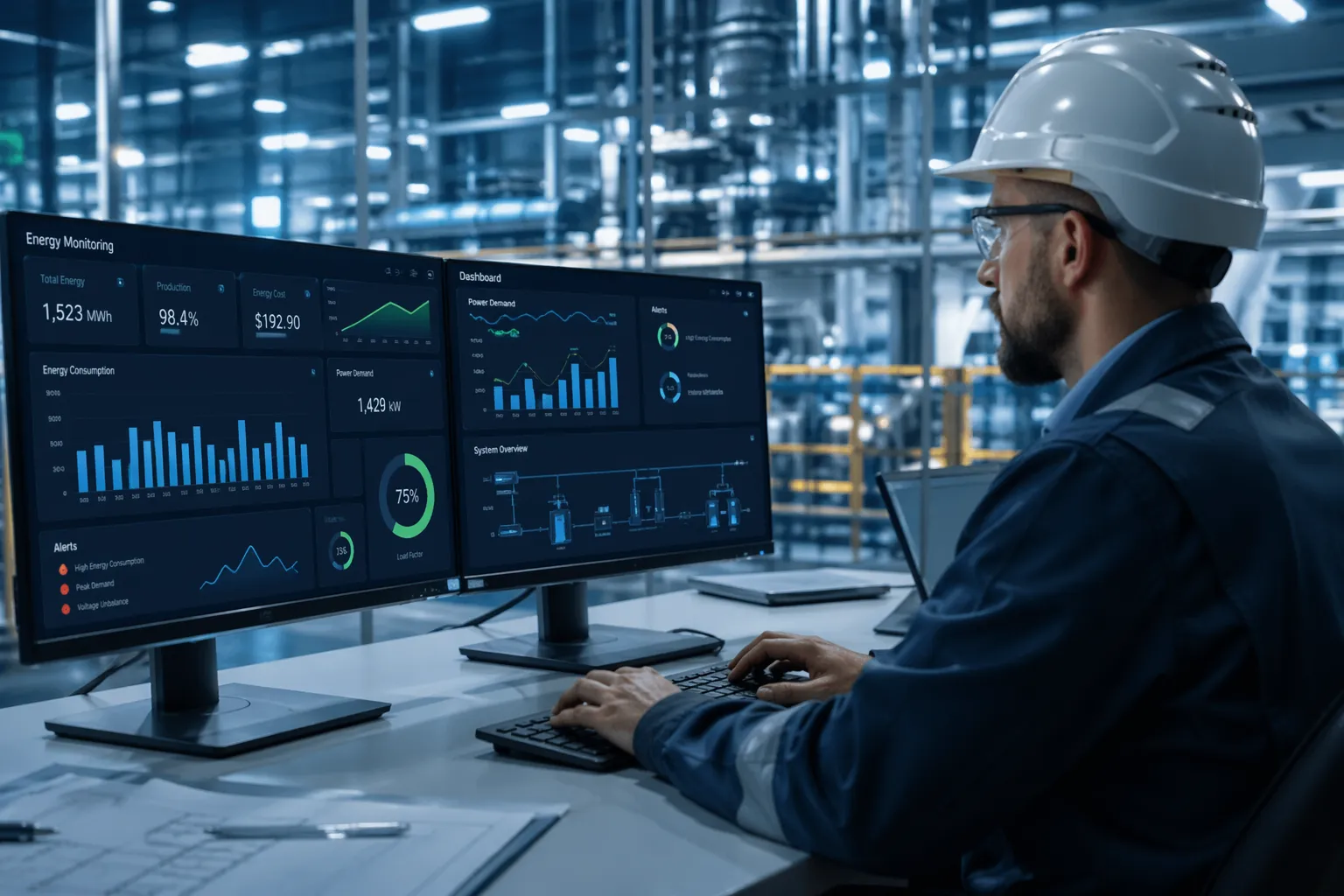
A key change is the shift from static reports to Energy Management Systems (EMS), which integrate data from meters, SCADA systems and BMS. Instead of monthly statements, the company receives an up-to-date picture of energy consumption, often broken down by processes, production lines or equipment. The data is analysed in real time, enabling immediate detection of deviations from the norm, such as unplanned increases in energy consumption, equipment operating outside scheduled times or peak power exceedances.
Above all, such a system enables:
In the context of ISO 50001, this approach directly supports the requirements for monitoring, measuring and analysing energy performance indicators (EnPIs). The standard does not impose specific technologies, but clearly highlights the need for systematic data collection and evaluation – which is why an EMS becomes a natural tool for translating these requirements into the organisation’s day-to-day operations.

Modern systems not only monitor but also automate operations. Examples include automatically switching off equipment outside production cycles, optimising the operation of compressors and HVAC systems, and managing load during peak hours to reduce contracted power costs. AI algorithms are also increasingly being used to analyse historical and real-time data, detect anomalies and forecast future energy consumption.
This approach reinforces the principles of ISO 50001, particularly in the area of continuous improvement. The system ceases to be a passive reporting tool and becomes an active mechanism supporting operational and investment decisions. Data not only describes reality but begins to shape it through recommendations and automatic corrective actions.
The biggest change brought about by automation is the shift in the timing of the response – from post-billing analysis to real-time action. Energy ceases to be a cost analysed retrospectively and becomes an operational parameter that can be actively controlled and optimised whilst the plant is in operation.
This also means making fuller use of the principles of ISO 50001 – from monitoring and analysing indicators, through identifying significant areas of energy consumption, to implementing corrective and preventive actions. Automation and digitalisation mean that these elements are no longer a periodic process, but a continuous and largely automated one.
The combination of EMS systems, automation and data analytics is transforming the way companies approach energy – from a reactive to a proactive stance. ISO 50001 provides a methodological framework here, whilst technology supplies the tools that enable its practical implementation in a company’s day-to-day operations. As a result, energy management ceases to be a reporting task and becomes an integral part of the company’s operational management.


DJB DORADZTWO
Marcin Chorąży


